Pages

Saturday, 21 June 2014

Dark Raid Review

Dark_Raid_CODEX
Platforms: PC
Reviewed On: PC
Developer: Vector Games
Publisher: Vector Games
Singleplayer: Yes
Multiplayer: Yes 
This game was tested using an AMD Radeon HD 7790 graphics card kindly supplied by AMD. Click here for details on that, the Radeon HD 7790 and the test system used for all PC games.
Dark Raid is a game in which you’re invited to “load chekpoint” upon death, and enter a “quick mach” under the multiplayer menu. Regardless of your budget, developers, an inability to check spelling is just plain annoying and hardly inspires confidence in your product. These are hardly the only spelling errors within the game, though, and represent just a small portion of Dark Raid’s far larger problems.

Given the clearly limited budget that the developer’s had to work with it is at least a sensible decision to take inspiration from the likes of Quake, Doom, Wolfenstein and even Unreal Tournament, the kinds of titles that don’t require vast amounts of cash to pay homage to due to their relative simplicity. And that’s exactly what Dark Raid wants to do – It wants to replicate the glory days by bringing back fast-paced, strafing and shooting in big environments. It’s an admirable goal and one that Dark Raid all to briefly manages to capture before you realise that all this is is a poorly made FPS which struggles to nail the three core tenants of shooters: weapons, enemies and level design.
2014-06-09_00010
So, here’s the setup. You play as a seemingly normal robot worker with a strangely gruff voice called Muddy, who must take up arms when a mysterious virus causes every other robot on the spaceship S.W.A.N. to go bonkers. Along the way you’re guided via radio by humans you’ll never meet, and must discover why you alone are immune to the deadly virus. The script is paper-thin and poorly written to boot, filled with terrible spelling errors, awkward sentences and equally poor voice acting. However, given the nature of the game’s desire to go old-school a lackluster plot is hardly something I can overly criticise. One can hardly look back at games like Return to Castle Wolfenstien, Duke Nukem 3D or Doom and – with a straight face, mind – declare them masterpieces of storytelling.
But unlike the classic shooters Dark Raid’s atrocious attempt at telling a story actually gets in the way of the gameplay, a sin that I find much harder to forgive. There’s far too many moments where you can’t advance until you’ve sat through a minute or more of text that’s written far too small for anyone with bad eyesight to see. Furthermore about half-way through the story the voice-acting dries up, the game citing a broken radio as the cause, switching over to the simple text communication. From a storytelling perspective this decision doesn’t add anything to the game, so I’m going to go out on a limb and assume this was done merely to avoid having to record more lines.
A game like this rides completely on the feel of the shooting, since that’s what you’re going to be doing for a large chunk of the playtime, although the reality of Dark Raid is that you’ll spend the majority of your time trundling through massive, boring rooms made of grey metal, looking for a couple of things to blast before moving on. The small budget and inexperience of the developers is at its most obvious in the bland visual design which places you firmly aboard a gigantic spaceship filled with vast rooms, which are in turn filled with…nothing. Seriously, very few of the rooms you ever visit appear to have a genuine function past being bloody massive or storing a couple of tiny crates that somehow manage to look embarrassed about being there. It’s not until fairly late into the six hour runtime that you’ll get a change of environment, the grey rooms swapped out for uninspiring science labs which all look practically the same. However, the weapon models do at least look decent.
2014-06-09_00011
While movement feels quick and responsive, managing to successfully imitate the games of old in this regard, the guns themselves are terrible, lacking in both recoil and satisfying audio. The lack of kick on the weapons (not counting the stiff animation in which Muddy’s shoulder and arm moves slowly upwards) means you can simply point the crosshairs at the enemy and keep the trigger pulled, removing almost all vestiges skill from the game’s strafing combat. Shooting the robotic enemies provides absolutely no feedback as they soak up bullet after bullet with zero visible effect before finally crumpling into a heap, defeated. Guns must feel powerful through the use of audio, animation and impact upon the enemy in order for the player to find combat truly satisfying, but Dark Raids fails in all three areas. This mixture saps almost all enjoyment to the back and forth strafing action, which is otherwise simple and lifeless.
The selection of weapons presents further problems. The shotgun is a beast and quickly proves itself to be a more effective weapon that most of the rest of the armory, able to decimate foes from a considerable distance, making it the go-to gun for any situation. The assault rifle, meanwhile, feels rather weedy thanks once again to the lack of recoil and satisfying audio, while also taking quite a while to put down a single enemy. The grenade launcher feels useless because spaces are so large and empty, meaning you have to hit enemies directly with the grenades in order for it be marginally effective, assuming the wonky physics choose to play ball with you. As for the pistol, it provides infinite ammo, which is handy because it’s also frustratingly inaccurate, making strafing fights feel more like pot luck than skill.  And then there’s the sniper rifle, a living embodiment of strange game design. This one-hit wonder features a handy zoom function in which you hold down the right mouse button until it reaches its maximum optical reach or until you want to stop. Sounds fine, right? Except, if you stop zooming, and then decide you’d like to zoom in a little further and press the right mouse button again Muddy helpfully stops looking down the sight, returning the gun to hip-fire position. Who designs a sniper rifle like that? Nobody! Because it’s stupid!
With the central pillar of combat the game is already fundamentally weak, so what about those other two things that shooters need to nail, namely level design and enemies? The environments you do battle in are about as basic as they come, with a mixture of huge spaces that often have two levels and tighter, more confined areas. This is a purely linear game with nothing to discover past pointless trophies, eschewing older shooters love of having sprawling levels to navigate, mazes filled with enemies, secrets and keycard doors. As for the enemies they are primarily made up of robots which come in just a few flavors, each only differing in how much damage they can take and slightly altered behavior patterns from the extremely basic AI that offers minimal challenge. To make up for lack of difficulty a couple of irritating tricks are used. Suicide drones that can insta-kill you with a single blast present the single greatest danger, especially as they have a habit of hiding in awkward places and can be a bitch to shoot down with anything other than a shotgun or minigun. Defensive turrets and standard robot enemies tend to be placed so they can get the first couple of shots in as soon as you step through a door. This can be especially frustrating when facing off against robots armed with shotguns or the powerful sniper rifle. At one point in the game I came across a section where I got stuck for a while as an enemy wielding the sniper rifle was able to kill me in a single shot due to my low health and also due to being neatly placed to get the first shot every time with a supreme level of accuracy seemingly granted by God himself. The incredibly thin roster of enemies is disappointing given how far older games managed to deliver a more exciting line-up of varied foes to battle against, often in just the first level, while also featuring better AI and avoiding resorting to cheap enemy placements to create a sense of challenge.
2014-06-14_00002
The game occasionally attempts to mix in some platforming sections, forgetting that unless handled with utmost skill first-person platforming is usually more frustrating than anything else. Thankfully there’s not too many of these areas, but when you do encounter one expect anger to be the primary emotion coursing through your soul as the controls just aren’t precise enough nor are the sections well enough designed.
And then there’s some things that aren’t major problems, but still baffle. Things like sprint, double jump and armor mode are unlocked completely at random throughout the game, with no explanation or reason behind them. You’re just playing and suddenly a text message says you can now sprint. Considering there are several points during the game where Muddy experiences flashbacks that explain his combat abilities it would have made far more sense to tie these upgrades into those moments. Hacking doors and other things is briefly introduced within the first hour as a basic mini-game and then promptly forgotten about until near the end of the game, giving the impression that the developer quite literally forgot about hacking’s existence.
The Steam page promises “Old-School Boss Fights,” a claim that genuinely excites in an age where bass battles tend to be lackluster efforts, at least until you discover that what it really means is a single boss fight that’s wrapped up in a few short minutes. That’s right, there’s just one boss fight, and it’s not even used to finish off the game.
Ah yes, the ending. Though the plot is already as thin as they come you need not worry as nothing will be spoiled here, but regardless it’s worth talking about Dark Raid’s finale. Not only does it fail to achieve a satisfying crescendo from a gameplay perspective, tasking you with simply battling the same enemies as before in a scenario no more challenging than usual, it also can’t bring the story to a climax, either, answering absolutely nothing while still managing to set itself up for a sequel.
Rather than opt to go with the manual saving system that the majority of this game’s inspirations utilised back in the day there’s a checkpoint system in place instead, but rather than the game automatically handling this players must go up to specific boxes on the wall and activate them in order to save their progress. Checkpoints are sporadic and almost seemingly random in their placement. Sometimes they’re close together, other times you can go for quite a while before seeing one, making death due to environment or cheap tactics all the more frustrating. Easy sections might have relatively generous checkpoints, while harder areas with lengthy text discussions between Moody and the humans won’t see checkpoints for 15-30 minutes, forcing you to trudge through dull combat scenarios or sit through duller story upon restarting.
2014-06-16_00004
Before we wrap up this review the multiplayer segment of the game must be tackled, because here we find a rather serious problem. Despite this being a full release, priced at a relatively expensive £14.99, and advertising a multiplayer component on the Steam storefront, a trip to the multiplayer menu reveals a large “Beta” banner. If you want to sell yourself as a complete package, then there should be no beta component, unless it’s clearly advertised in the game’s description, which in this instance it is not. That’s utter bullshit, Vector Games. Get it sorted.
I’d like to tell you more, but unfortunately I was unable to get a single match as nobody is playing, and I was unable to rope some friends into proceedings. However, one can set up a custom game and include bots, but of course this relies on the basic AI that powers the singleplayer campaign. Currently modes are limited to Death Match, Team Deathmatch and Capture the Flag across a total of three maps. I feel bad about reviewing a game without adequately exploring its multiplayer suite, and thus offer my sincere apologies, dear readers, but playing against bots would not provide an adequate test.
For all of its many flaws, there are some rare moments when Dark Raid is fun, and manages to evoke feelings of playing Quake or such  for the first time. There’s glorious moments where that mysterious sense of flow is achieved as you sprint from room to room, gunning down enemies without them getting a single shot in against you, but as quickly as it comes it vanishes again, leaving you to lament its loss.
Perhaps the biggest compliment I can pay Dark Raid is that at least it’s relatively bug free. The game ran smoothly enough and aside from numerous spelling mistakes I didn’t encounter a single major glitch that hampered my experience over much, although there were a few times when I had to ctrl+alt+del out of the game when it seemed to get stuck during loading. Jumping back to desktop and then back to the game seemed to get it back on track. I also encountered a few enemies that had been placed facing the wrong direction, and therefore wouldn’t react to my presence until I stood directly in front of them. Being mostly problem free means the game deserves to stay away from the lowest score, but ultimately not by much because Dark Raid is simply a very boring game. It’s completely bland, uninspired dross that neither captures the spirit of classic shooters or finesse of newer offerings.
As a final note this is why I often feel apprehensive about tackling indie games, because when I write a review this negative I end up feeling like a complete jerk, and worry that in the case of a small, brand new company like Vector Games my harshness could ultimately contribute to them choosing to throw in the towel and never develop another game. I sincerely hope that’s not the case, and that Vector keep going. Perhaps down the line they’ll be the next big thing.
But ultimately when writing any review my loyalty lies first and foremost with the consumer, the person who is spending money on a product. Whenever any developer, be they Ubisoft or Vector Games, puts a title on the market  it comes with a set of expectations, a level of quality that the consumer demands, and must therefore be critiqued as such. Dark Raid serves to show that Vector Games need to hone their craft further before attempting to sell their work.
For a few bob Dark Raid would be worth your time merely for a laugh, and the multiplayer could potentially be enjoyable once finished, though it’s unlikely to find much of an audience now. But as a game there’s really very little to recommend about it.
watch the gameplay here:- www.youtube.com/watch?v=o4lIU_BCOrA

Murdered: Soul Suspect Review – Casper, The Friendly Detective


 murdered_fob_1391526434
Platforms: Xbox 360, Xbox One, PS3,PS4 and PC
Reviewed On: Xbox One
Developer: Airtight Games
Publisher: Square Enix
Singleplayer: Yes
Multiplayer: No
A good detective story has the capacity to keep its audience in thrall until the very end, but is also requires spot-on pacing in order for it to work. The mystery of the killer needs to be kept alive until the very end, but along the way the audience needs to feel like they’re learning enough new information to keep them theorising and interested. The final reveal needs to be shocking but logical.

Developers Airtight have taken the concept of your average whodunnit one step further,  introducing a brilliant setup for their game. You play as one Ronan ‘o’ Connor, a man with a hell of a rough past. His body is adorned with tattoos, each denoting an event from his life, such as a near death experience when he got stabbed during a fight. After meeting the love of his life Julia, Ronan manages to get things on track, and with the help of his new brother-in-law/police officer Rex, joins the force, eventually becoming a Detective by smudging the paperwork a little in order to hide some of his worse offences. Still, life ain’t done with Ronan, and his wife is murdered by a gang of thugs, a simple victim of random crime.
murdered_online_preview__2__1393429484
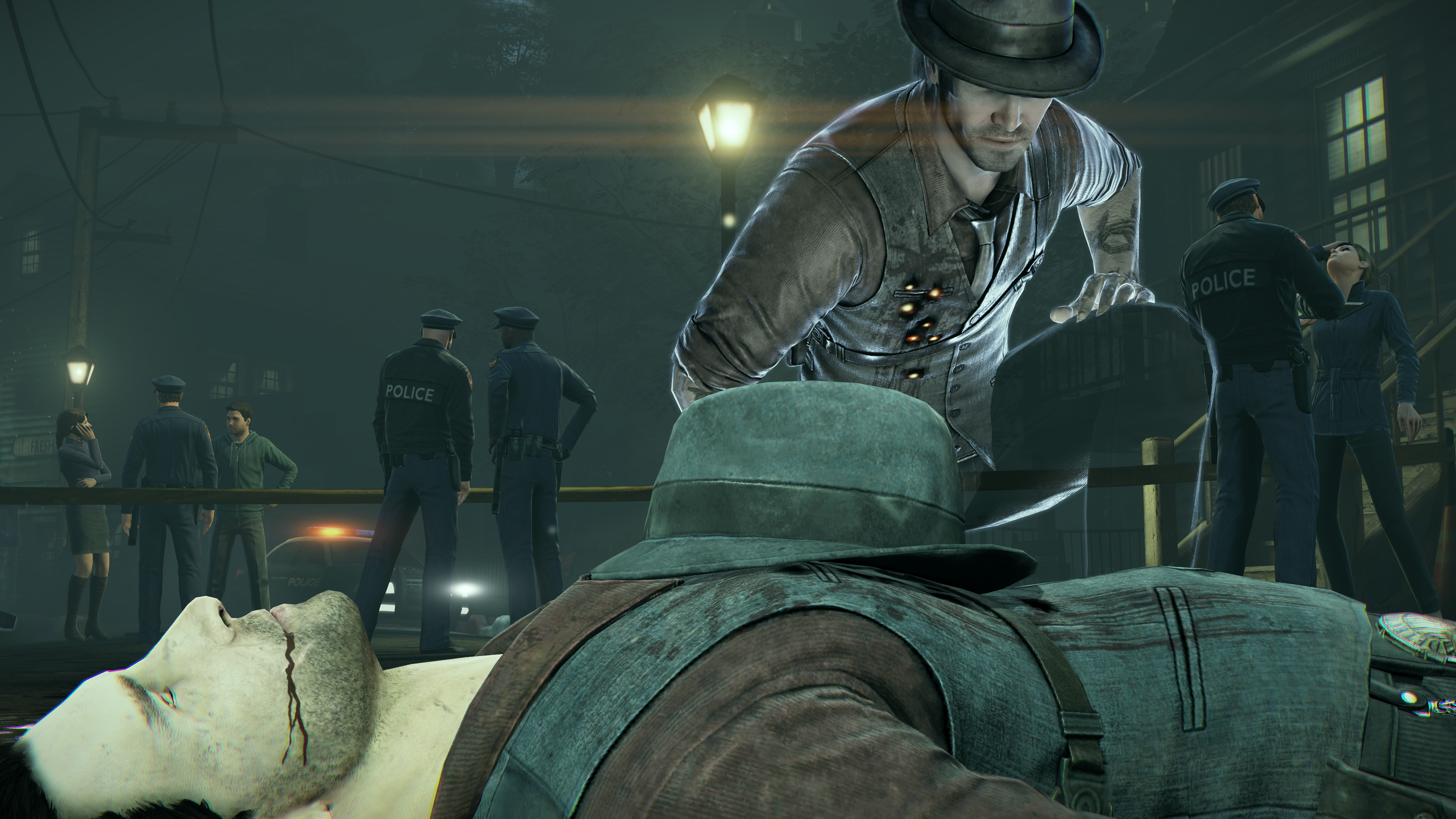
The game picks up three years after this event, and Ronan, now taking even more risks than normal, is working a case to track down the mysterious Bell Killer, a murderer responsible for numerous gruesome deaths. Having managed to track the killer down Ronan proceeds to charge in without backup, and as a reward get’s thrown out of a window from several stories up. Just to be sure the job is done, the Bell Killer grabs Ronan’s gun and proceeds to sink seven rounds into the detective’s chest.
If you’re now screaming in rage, wondering why I spoiled the ending, then you should probably settle down. This is not the end of Ronan’s tale, instead it’s merely the start of the game. From his own corpse the ghost of Ronan arises, obviously more than a little shocked at this strange turn of events. He’s trapped in the world he once was alive in, unable to touch anything or talk to anyone, a spirit lost in limbo. In order to move on and reunite with his lost love, Ronan needs to complete his “unfinished business” and figure out just who the Bell Killer is.
Given his chequered past and initially gruff exterior Ronan could have easily become just another generic protagonist, but solid writing and a talented voice-actor make him incredibly easy to like. He’s tough, but smart and surprisingly caring, a man who understands how the world really works in ways that his fellow policemen and detectives can’t, a fact that has earned him several enemies among the force who feel he’s little more than a criminal. Matched up with Ronan is teenage medium Joy, a trouble teenager struggling to deal with her ability to see the spirits of the dead, Like Ronan she’s instantly likable. Dressed in black with a couple of piercings, like Ronan she has a depth and warmth to her personality that draws you in, while the similarities and contrasts between the pair make for some strong banter.
murdered_online_preview__1__1393429480
The mystery itself is generally handled well. The dialogue doesn’t always come across as completely natural, but a strong cast of characters manages to make up for it, although Rex in particuilar, Ronan’s step-brother, could do with much more time in front of the camera. Indeed, at around 6-hours the entire story feels like it needs more time to breath. Still, within that time the pacing is excellent, always delivering another interesting snippet of information at just the right moment to keep you guessing and creating theories. Like all good mysteries, at least in my eyes, there’s enough clues presented that a player with an eye for details could actually deduce the killer’s identity, or at least make an educated guess, and even if you don’t then the final reveal will click everything into place neatly. Having said that, the plot does rely on a fair standard contrivance within the mystery genre to help throw you off the trail, which I can’t mention as veterans of the genre will then probably be able to figure out the culprit too easily when playing. There’s nothing wrong with using that method, but I’m personally not a fan of it as it did mean I had a strong suspicion before the final reveal.  Another point is that the killer himself/herself could have done with having their motivations fleshed out just a shade more, as their past is a little vague.
Despite these few shortcomings, however, I was invested in the story from start to finish, thoroughly engrossed in discovering Ronan’s killer and helping him move on. As cliche as it is to say this, and as much of a bad pun it is too, Soul Suspect’s story has something often lacking in triple-A creations: soul.
Arguably the strongest decision on the developer’s behalf is choosing the infamous town of Salem as the location for their supernatural tale. While the few NPCs that wander the streets do a poor job of making Salem feel like a genuine place filled with people going about their lives, the sheer weight of  the real Salem’s past adds a powerful sense of gravitas to its virtual counterpart, although obviously if you’re unaware of its troubled history then it’ll have a far lesser impact. Even if this is the case, though, the streets of Salem are filled with the faint souls of those who gone before, while ghostly chunks of a far older Salem are visible, often running across roads or through buildings. The entirety of the game takes place during the course of a single evening, and a gentle fog hangs over the town. Salem may not feel alive, but it’s dripping in atmosphere and serves admirably as the backdrop to Ronan’s story.
murdered_online_preview__11__1393429509
Yet, even with the power of current-gen consoles it’s disappointing that Salem is not a seamless world, but rather a series of story locations connected to a single centre hub. Journey to the Church in order to investigate and you’ll be herded through a brief cutscene that feels like it’s their to hide the level loading in. Attempt to venture somewhere you’re not supposed to be going just yet and you’ll be herded back to the current area with a comment from Ronan. Nor is Salem exactly a vast place to explore, although scattered around you’ll find plenty of collectibles that provide some great background to the story, such as the collected thoughts of Ronan’s wife Julia, and plenty of stuff that details the brutal history of Salem. As you wander around there’s also ghosts to be found trapped in limbo who you can help move on the afterlife, although these are disappointingly rare, a great shame when the few that exist are brilliant little stories in their own right and are worth going out of your way to find and complete.
As a ghost you’re able to walk straight through normal walls and objects, and so the developers have managed to use Salem’s history to guide players around, a clever move on their part in order to keep things moving along, even if it does somewhat damage the fantasy of being a spectral spirit. Every building within the town of Salem has been consecrated, meaning the only way to gain entry is through an open door or window. Once inside a building, though, you’re free to pass through the walls, a disconcerting power to begin with that requires you to abandon all previous videogame experience but that quickly becomes normal. Back out in the streets of Salem and those ghostly apparitions of the old town also serve as a method of carefully corralling you. Ordinary living citizens can pass through these pale blue walls, ships, and walkways, but as Ronan you physically can’t. While like being unable to simply walk straight into a building this somewhat damages the fantasy of being a ghost, it’s easy to forgive the developers considering how much of a headache designing a game where the player can literally walk through everything would have been. At least they managed to work these restrictions into the actual plot in a way that makes sense, unlike the strange glowing pools which arms stretch forth from to grab Ronan and drag him down to his second death, which are vaguely explained away by the plot but are the most absolutely obvious method of directing the player.
The bulk of the gameplay is composed of using your detective skills to piece together what happened in a crime scene, and thereby slowly build a picture of the overall mystery. Upon entering a crime scene your first goal is to begin scouring the environment for clues, the total number of which can be found is displayed at the bottom of the screen. This simply involves looking for a likely object, wandering up to it and tapping the X button, at which point you’re usually granted a brief piece of text and the clue is added to your list, although sometimes you’ll also be rewarded with a quick flashback sequence. Other than merely hunting for objects you’ll also occasionally need to possess and influence a person in order to get them thinking about a something specific. To do this you need to select one of the clues you’ve already found which you believe may spark the required thought, as hinted at by the floating text above the person’s head. Sometimes you’ll also need to possess somebody in order to look through their eyes, or activate a fan to move some paperwork using your poltergeist ability, a power that’s oddly underused. Finally, you’ll sometimes find a residual static image of an event, and must choose from a series of floating words those that you think describe the emotions or actions of the scene best. For example, a young girl peering round the corner at Bell Killer is obviously scared, hiding and watching. In order to conclude a case you must choose several of the clues you’ve gathered that best answer the question Ronan has posed about the crime scene, such as why the killer was there.
murdered_online_preview__9__1393429501
Although the game firmly places you into the transparent shoes of a detective you’ll never truly feel like one. The game actually tells you when you’ve gathered the required clues needed to conclude a case, so it’s entirely possible to actually pick up the three needed straight away, while the solution itself is always blatantly obvious. Furthermore it’s actually impossible to fail or draw the wrong conclusion. Your only punishment for not picking the wrong combination of clues is a lower rating in a scoring system so arbitrary that it’s entirely possible to go through the entire game without even realising it exists. There’s never a eureka moment, a spark of intuition as you work through the available evidence and arrive at a startling conclusion. There’s never a sense that you personally are working anything out, but rather that you’re just along for a ride in which you’re occasionally asked a simple question to which the game has already strongly hinted the answer to.
After a while it honestly begins to feel like the developers thought their audience were idiots incapable of piecing together even a simple crime scene, mere meat-sacks whose brain has been so burnt out on shooting stuff that we can’t comprehend anything past a gun. I genuinely don’t believe that this is truly what the developers thought, but it’s certainly what it can feel like at times.
In their defense, however, creating a game where you take on the role of a detective seems to be quite a demanding challenge. Even L.A. Noire largely failed to create gameplay systems that truly made you feel like a detective, while the Batman games also struggle to depict this aspect of the Dark Knights layered personality. Make the investigations too difficult or even realistic and people can get frustrated, while making them too easy, as they are here, is just as bad. This is why I keep angrily batting down all suggestions that they attempt to make a game out of the Sherlock TV series, at least until I’ve seen some proof that someone can make a game where I truly feel like a detective.
You’ll never throw a punch or fire a gun during the entirety of Souls Suspect, but that doesn’t mean you’re free from danger, as apparently being dead isn’t enough. Demons occasionally pop up and rove the environment, looking to devour your soul, which is, you know, nice of them. You can’t tackle them head on, instead you must walk up behind them (there’s no actual sneak button) and perform an execution by holding down the right trigger, followed by a contextual command. Should you happen to get spotted then you’ll need to run for it and take cover in strange, floating residue from spirits that have faded away. The demons will search these hiding spots, and so you must flit between then with a tap of the right trigger until your foe lost interest and wander off to resume their never-ending patrol.
murdered_online_preview__8__1393429498
The first few encounters with the floating demons is tense and exciting, their arrival in the world heralded by a hell of a scream which will likely get the hair on your neck standing to attention, but those feelings quickly wear away as it becomes apparent that they represent very little danger. Hiding from them simply means jumping from spot to spot until they get bored, the only key skill required being to keep another hiding spot within distance. Even if you get discovered you can simply leap out and run over to a new spot and start the hide ‘n’ seek sequence again, patiently waiting for them to go back to doing demon things so you can destroy them. The only other element of note is that ghostly crows occasionally provide a way to distract demons. As a gameplay mechanic the demons are just too easy, and evading them grows tiring far too quickly.
So, what else does Soul Suspect offer? Well, there’s the occasional escort mission where you guide Joy through a building, using your ghostly powers to turn off cameras and distract people by activating a TV or some such. Unlike most escort missions these sections are frustration free, but that’s only because they’re impossible to screw up and extremely easy. Like most of the game it’s the banter and relationship between Ronan and Joy that keeps things interesting. Possessing a cat from time to time is also a thing, because for whatever reason their minds are malleable enough for you to take control of their bodies, allowing you to make your way through vents or other areas otherwise impassable.
And that’s just about it. When you get down to it Soul Suspect isn’t a game with much going on to talk about. You can possess the people wandering the streets in order to read their mind, but it’s hardly worth it given that they each have just two lines of thought.  Other ghosts can be found around Salem that cannot be helped, their plight evoking sympathy despite the lack of actual time given over to their individual stories, such as the guy who was the victim of a frat prank gone wrong, and doesn’t even realise it. Encounters with these people make the game feel like it was created on a tight budget, because if the developers had more cash at their disposal then I imagine the world would be a little bigger with more of these ghosts around offering side mysteries for you to solve, or stories to take in.
large
There’s also a dialogue system in which you can choose what to ask a person next, but it feels rather half-hearted in its inclusion. Mostly you just have two options to pick from, and asking one opens up another one. It hardly brings much diversity to conversations. There were also several encounters where only one option is presented, the selection of which opened up one more and so on, making the whole damn thing utterly pointless. If you’re only going to provide a single selection, why not simply make it a standard cutscene, especially since there’s a strange transition between someone speaking and the dialogue selection popping up.
Soul Suspect’s narrative kept me engrossed from its opening moments to its finale, more so than most other games I’ve played over the past couple years. It’s not the most smartly written, but the intriguing setup, choice of Salem as the locale and characters kept me hooked. It’s just a shame that from a gameplay perspective Soul Suspect flounders, unable to create a compelling play experience to match the plot. This is a title for gamers who appreciate a good story more than anything else, then, and can forgive the shoddy gameplay.
What it truly has going for it is being utterly unique, playing like nothing else on the market. It’s heavily flawed, but quickly draws you in with its clumsy charms.
So now it’s time for some contradictions. Despite the scores awarded, on a purely personal basis I’d recommend this over something like the recently released Watch Dogs, despite Ubisoft’s game being the technically more sophisticated and impressive game. The story, characters, setting and ideas all clicked with me, largely due to my love of mysteries and the dark fascination that most people seem to have with the supernatural, regardless of beliefs. It’s quirky and brilliant, yet due to its clear flaws I cannot fairly award it a higher score.
watch the gameplay here:- www.youtube.com/watch?v=olFz8mV1FWE

Freaking Meatbags Preview – Seriously, Those Freaking Meatbags


 splash-screen-with-logo
Platforms: PC
Developer: Wild Factor
Publisher: Plug In Digital
Singleplayer: Yes
Multiplayer: No
This preview is based on an early access title.
If there’s one thing we’ve learned from history is that humanity is essentially just waiting around for either an incredibly intelligent AI of our own devising or a bunch of aliens to turn up and enslave us all, because when put under the whip we make a solid, if slightly whiny, labour force. True story.

So, here’s the setup: you are a robot tasked with mining resources from the far reaches of space at the behest of your metal  boss. The problem is the boss’ wife has taken a liking to the squishy humans that inhabit  some of the planets, and has requested that you do your best to protect them, which is a small problem given that hordes of insane, wild robots launch attacks every night. In order to defend the humans, then, you have to drag their sorry hides around with you from planet to planet and use them to mine resources, which are then spent on constructing defenses to save their worthless squishy lives. Seriously, screw those freaking meatbags.
2014-05-24_00005
It’s a situation that cannot be taken seriously, so it’s a good thing that the static screens filled with dialogue are well written and genuinely funny. Emails arrive from your mom back home who insists that you wear your hand knitted jumper and that lasers only hurt when they hit you in the face, while your own robotic character desperately tries to find out if using resources to save humans is going to get him fired, or if any help is coming, because that would be great. Please.
Once you’ve been dropped onto a planet the first thing you need to do is allocate your supply of humans to resource collection, quickly judging what you want to grab and at what rate. Basic metal is used in the construction of walls and machine gun towers, while other materials are needed for creating rocket towers and other things. Defenses in the game’s current form are limited to simple walls, machine gun towers, rocket towers and lasers towers, and you simply toss them down in the general direction of the incoming enemy horde, indicated a short while before a wave attacks by a red icon flashing on the screen. Should you the enemy engage their brain for a second and decided to launch an assault from the other direction you can recycle existing defenses before hurtling over to the front line and redeploying your stuff, picking and choosing which weapons to use depending on the enemy type. Big, bad bull bots, for example, can largely shrug off machine gun fire, so rockets are the way to go, especially if you sink some resources into upgrading them a time or two.
Completing a planet rewards you with a chunk of gold that can be used to buy new stuff, but there’s also an interesting risk vs reward mechanic at play on the planet’s surface as you can send humans to mine gold deposits as well, which obviously stops them from gathering the materials required to build your defenses. It’s a clever idea, but one that’s let down by the fact that unless you’re able to devote your entire workforce to mining gold for a large amount of time, the rewards aren’t really worth the effort, especially given the very limited selection of items to buy.
When you’re not on a planet saving humans and blowing up robots there’s a shop you can visit in order to purchase some new equipment. Some of it is specifically for your humans as it boosts willingness to work and productivity, while other stuff is for defense. It’s a barebones selection of stuff at the moment with two items locked off due to its Early Access nature, but I have the sneaking suspicion that there’s not going to be much more on offer in the full game either, reinforcing my belief that Freaking Humans is fun, but doesn’t have a whole lot to offer. I have no way of knowing if my assumptions are correct, though, as a visit to both the Steam forums and official game website reveals no published plans from the developer or indications of what’s coming down the line.
2014-05-24_00008
A second shop offers up upgrades for your robot and other things purchased by spending Cores which are gathered from fallen foes or from around the environment. These vary from bumping up the speed of your bot to increasing the health of the main base or giving you more storage space for humans.
Back on the ground there’s a couple more building options for you to play with, assuming you’ve bought them from the shop. Placing a mechanised mine down on top of a patch of resources bolsters production by 200% while a pathway of booster pads can be laid to speed up your fleshbags at minimal cost. Explosive mines can also be laid out for unsuspecting robots to wander over.
One of the features the game touts proudly on its Steam page is DNA Fusion, the act of combining the DNA of two beings to produce a new fleshy thing for you to boss around. Don’t worry, the original two subjects survive the process as well. If you combine two humans then only their common traits will carry over to the creation, but if you throw an alien into the mix then that aliens abilities will also carry over, granting your new creation  such awesome things as laser eyes or being able to explode violently. Look, I never said these abilities would be something the hybrid would actually want personally.
The game’s official webpage describes Freaking Meatbags as, ” real-time strategy game that’s all about building a base, mixing meatbag DNA, then convincing those dolts to help you gather resources.” It’s a sentence which conjures images of armies, varied buildings and yourself seated in a chair, blithely yelling orders and looming over a strategic overview of the battle. But in truth what Freaking Meatbags is, is a pretty basic tower defense game. You throw down some defenses, perhaps using the environments natural chokepoints, and that’s about it. Managing the humans is simple, there’s minimal thought required to defend your base, and there’s little else to worry about. The gameplay is occasionally mixed up by having the base element removed entirely, leaving you to meander round a planet, gathering up weapon pods for your robot and using them to gun down the wild robots, at which point Freaking Meatbags becomes a simplistic shooter.
 Freaking Meatbags is….okay. And that’s all I can honestly say about it. I’m struggling to find a whole lot to talk about that doesn’t amount to me just saying it’s okay in a slightly different way. There’s certainly nothing bad about the game. Indeed, for an Early Access title it’s surprisingly polished and free of bugs, and for 20-minutes or so it’s quite fun. But then you’ll get bored, turn it off and completely forget about it until the next time you fire up Steam with a spare half-hour of time and remember that Freaking Meatbags is still in your library. You’ll enjoy it again briefly, and then forget about once more. Maybe that’s enough. Maybe.
Development is far from finished yet, and thus Freaking Meatbags has plenty of time to be improved upon, and doubtless when it finally releases I’ll come back and offer up my final thoughts, but in its current state there’s not much for me to recommend here. Although the official website nor the Steam page offer any insight into where the game is going from here, screenshots and trailers released by the developers show several more buildings that could potentially bolster Freaking Meatbags greatly. With a more varied selection of buildings and the opportunity to construct larger bases, this could become a great little strategy game.
But here and now, at this very moment, it’s a mildly enjoyable, very simple strategy game with a strong sense of humour but little in the way of actual gameplay to hold one’s attention.  I want to love the game because it has an undeniable charm produced by its wonderfully retro graphics and its indie spirit, but I can’t just yet. The potential is there, now it just needs to be realised.
watch the gameplay here:- www.youtube.com/watch?v=hCMBJB4_FCI

Friday, 20 June 2014

Sniper Elite 3 Preview

 Sniper Elite 3
Everyone loves to be the sniper and hates to be sniped, a fact that’s probably played a huge part in the popularity of Rebellion’s Sniper Elite series over the years. Sniper Elite has proved to be a stable franchise for the Oxford based developer, so it’s not a big surprise that they’re currently working on the third game in the series.
Creating an authentic sniper game is a tricky business. Sniping is a real skill that needs to be mastered, with many variables such as bullet drop, weather conditions and even breathing to be taken into account. These are just a few factors Rebellion have been working on to make Sniper Elite 3 feel like you’re playing the role of a sniper during the WWII African conflict.
The demonstration at Rebellion’s studio last week took us through one of the game’s earlier missions called Halfya Pass, a vast rocky valley peppered with German soldiers. These new levels are much larger than we’ve seen in previous Sniper Elite games. In fact we were quite surprised at the scale of the level as the camera zoomed out to show the whole zone. It’s also important to note that the levels and objectives are not as linear as before, with players having multiple choices on how to tackle the map. Each level has multiple objectives, and how you approach these will be somewhat up to you.
Sniper Elite 3
Disguising a building as a beehive was a common WWII sniping tactic.
Spotting enemies is not always easy as they taunt you in their sandy coloured uniforms, but when you do get one in your sights, the target can be tagged. That way, you don’t lose track of them if either you or the enemy moves. Once tagged, the enemy is visible behind objects and is highlighted as a grey shadow. It’s up to you whether you utilise this feature or not, so if you really wanted to play this as realistically as possible and ramp up the difficulty and tension, it’ll have to be a tag free zone. It’s a feature that’s purely there as an aid that crosses the line between realism and a game, along with the radar which shows where enemies and key objectives are.
Realism is what Rebellion is trying to approximate through Sniper Elite 3′s interface, which comes with numerous visuals to aid the player as they sneak around a level. Staying hidden is important to your success and there’s a small eye shaped icon on the bottom left of the screen to indicate whether you’ll be easily spotted by the enemy. Shadows and cover are your best friends, and they need to be sought and utilised as much as possible.
Being spotted by the enemy is not an option, so Rebellion let you know when it’s a good time to get moving. If the enemy are triggered by noise or spot you there’s an indicator that pops up telling you to shift your sniperly arse and ‘Relocate’. In other words, move quickly away from the location you were spotted before it gets peppered with bullets. While you hide, guards will eventually give up looking. But if you’re chased down then it’s likely to be fatal, because health no longer regenerates.
Sniper Elite 3
Hello there, sir. Fancy a stab?
Making an effective kill will take some practice. Anyone who’s played as a sniper in a recent shooter will know that staying steady and regulating breathing is vital. In this game, your heart rate is indicated on the screen when the zoom action is activated and keeping still before pulling the trigger makes a real difference. There were a few times during the Sniper Elite 3 demo that shots were slightly missed due to movement, and when that shot doesn’t make a clean hit all hell can break loose. The longer you aim, the steadier the shot. So it’s worth taking time and keeping a close eye on that heart rate.
Staying hidden is not the only thing to worry about, because charging around the level like a bull in a china shop is not going to work either. The more noise you make, the higher the chance of being detected. Rebellion have taken this game mechanic and integrated it with the objectives.
At one point during the Halfya mission, for example, the player can sabotage a generator and cause it to malfunction. The resulting sounds alert the guards, who move in to investigate. With the generator now making clunking and banging noises, a sniper shot can be masked by the racket and go undetected. Later in the level, a loud hailer that was blasting over the German camp could also be used to your advantage. But timing is key to making that perfect shot in time with the game’s audio.
Sniper Elite 3
You thought you were safe but I’m going to split that skull.
Rebellion has made the ‘bullet cam’ a central feature of their sniping games. Even when playing Nazi Zombie Army there was a sense of satisfaction when you followed the bullet towards its intended target. It makes you feel, at least in my case, a little better than you probably are.

The bullet cam has been further enhanced in Sniper Elite 3, with some visual effects that are either gruesome, or quite tasty, depending upon how mentally disturbed you happen to be. As the bullet hits a target, usually a head, it cuts to a skull view showing where the bullet hit accompanied by some explicit skull shattering and blood spurting. It’s graphic stuff.
The bullet cam also works on vehicles, and in one sequence a truck needed to be blown up in order to cause a nice, noisy diversion. Taking aim at the engine cover it was blown off with the first shot. The second shot was fired directly into the engine, whereupon the camera switched to the bullet cam and you could see exactly where the bullet hit the engine as it cut to an internal view of the technical workings. A nice touch.
As we progressed through the level there were sniper nests, a new feature for Sniper Elite 3. These locations are dotted around maps and they make for perfect sniping positions. In one particular case, directly above a large petrol tank conveniently placed next to an armoured vehicle. You can probably guess what was going to happen next. By shooting off the petrol tank’s tap mechanism the explosion caused a chain reaction with vehicle after vehicle going up in balls of lovely flame.
Sniper Elite 3
Just catching some rays.
While the game is about sniping, there’s more in the Sniper Elite 3 arsenal to trick the enemy into dangerous situations, including traps and detonation devices. A cleverly placed mine at the top of a ladder can easily dispose of an enemy, and it’s best to think ahead by placing them down so that when you are spotted you can make an escape and leave at least one foolish pursuer dead. Even better, throw a stone and lure them to the mine with the noise then laugh as they explode.
TNT also proved useful in taking out the artillery gun which was one of the demo mission’s objectives. For some reason known only to the AI Germans, and Rebellion, there were petrol canisters placed directly below the artillery placement. Sneak underneath the gun, set up some timed TNT and it’s mission accomplished. Big gun goes up in flames taking the guards with it.
The big question is whether Sniper Elite 3 will be an improvement over the previous two games.
In terms of numbers, at least, this installment has the edge over previous entries. In Sniper Elite 2 the single player campaign was around 8 hours long; this time it’s 12. In Sniper Elite 2 the maps were linear, while in Sniper Elite 3 they look to be larger, and offer more approach routes. The previous game had around 8 AI on a level, but now there can be 30+, or “no limit” as Rebellion put it. In Sniper Elite 2 there were 5 vehicles, but now there are 9. There’s now more equipment to play with such as TNT and there are also more artillery units. Finally, there are now 15+ custom reticules and four loadout slots.
Sniper Elite 3
Packing more stuff in that belt this time.
There is one thing that does stay the same however, and that’s the actual weapons. Rebellion plan to release more weapons for Sniper Elite 3 as DLC once the game launches later this year.
Sadly, our demonstration did not include any multiplayer action, but we can tell you a little about what to expect. Sniper Elite 3 will handle up to 12 players in multiplayer as opposed to 8 in the previous game, with the promise of an improved lobby system. The whole campaign can also be played co-operatively with dual roles, the Agent and the Sniper, each with different tools at their disposal. I thoroughly enjoyed playing Nazi Zombie Army 2 in co-op so this has similar potential.
 I would like to point out that the demonstration we were shown was the PS4 version (booo!) but Rebellion did show the great strides they’ve made to make the game extra special for the now more powerful consoles and the PC.
The demo was in 1080p and the good news is that the PC version will be able to go to whatever your rig can handle. But it’s Rebellion’s tessellation technology that has vastly improved the visuals. An artillery gun model was shown with the old tech and it was square and really not very smooth. When the same model was applied to the new tech it looked brilliant. It was round, smooth and just a lot more detailed. This explains why Sniper Elite 3 is vastly improved in the visuals department, and why the characters now have more components for you to burst like bulging blood sausages with your bullets of death.
With consoles having caught up slightly with the PC it’s good to see that we’re going to be playing a Sniper Elite that can make use of the extra power.
With only one level on show it’s hard to tell how diverse the overall game will be, but so far it’s looking very promising. The thought of playing through this co-operatively actually excites me in a non-sexual way.
watch the trailer here:- www.youtube.com/watch?v=qL2T6BQvPY4

Grid Autosport Preview

 grid autosport endurance
It’s difficult to frame Grid Autosport as anything other than an attempted Codemasters apology to the Grid fans who didn’t appreciate the drift-happy antics of Grid 2. While that sequel’s looser, more arcade-focused approach was perfectly legitimate, it seemed strange to put the Grid badge on it when it handled so differently.
For Grid Autosport, Codemasters have been pushing the PR line that car handling will once again be closer to the original Grid. I’m certainly not here to confirm that marketing angle as gospel, but based on the work-in-progress preview code provided by the publisher the handling is less the back-end botty-wobbles of Grid 2 and more grip-happy. Depending, of course, on the type of vehicle you’re in, the race assists you have on and the discipline in which you happen to be competing.
grid autosport (2)
I’m coming for you, Yoshida.
Grid Autosport is structured around five distinct events: touring cars, open wheel, tuner contests, endurance and street racing. The latter probably comes closest to a Grid 2 “feel,” but all events have their own approach to handling and subtle skills to learn.
Each racing ‘season’ is dedicated to a discipline of your choice, during which you’re contracted to a certain team who have specific goals they want you to meet. Things like finishing at least 4th in the driver standings. Other secondary goals, such as improving your lap time during a race, can be met too; all of which earns you experience points towards unlocking more prestigious events in the discipline, and a shot at more demanding team contracts in the following seasons.
Team racing also means you’re going to be paired up with a bumbling team-mate, who you can command (via the returning verbose engineer) to either defend his position in the race or make a risky push for a higher finish. Calling them ‘bumbling’ may not be entirely fair, as this preview code had unfinished AI and early contracts with more lowly teams, but at one stage my partner almost rammed me off the track while I was well placed to win the driver’s championship. Perhaps in Grid Autosport’s world I’d been sleeping with that guy’s wife, I don’t know.
Just as in Grid 2 nothing I do is ever good enough for Mr. Engineer Voice man, although he did amuse me with a damage report of “everything looks good to me” just after I’d watched my car’s bumper clatter on to the tarmac and bounce away behind me. In fairness, he was right. It didn’t really affect my driving at all. Other, more serious, damage to gearboxes and the like can make the car pull to one direction of otherwise struggle to function.
grid autosport (4)
A lead of 00.00.11 seconds? The win was never in doubt.
The unfinalised nature of the AI racers makes endurance racing, in particular, difficult to assess. That event is all about the management of tyre wear throughout a longer than average race. All of preamble suggests that endurance is all about personal strategy; whether you aim to go all out early on and then try to survive on bald tyres for the last couple of minutes, or hold back and then push up with your superior tyres later in the day. In this preview build though, endurance played out like every other race with the AI sticking to its patterns and not really employing any noticeable strategy. Hopefully that’s one of the areas still to be ‘optimised’ before release.
They fared better in more straightforward events where the aim was simply “try to finish first, or as fast as possible,” but proved fairly simple to pass. It’s worth noting here that I stuck broadly to the medium difficulty level, which will of course have influenced the effectiveness of the AI to a degree.
Grid Autosport actually has a welcome method of rewarding higher difficulty play. The options within each default difficulty setting can be tweaked to your own liking (for a while I added ‘racing line’ guides to corners, which is something from a lower difficulty setting,) but this will impact the experience points you receive after a race. The more risks you take with disabling race assists and aids, the better your haul will be for succeeding.
Codemasters’ trademark ‘flashback’ feature returns in Grid Autosport (allowing you to rewind a mistake a limited number of times per race,) and is one of the options you can choose to disable in return for higher rewards.
grid autosport (1)
Endurance makes you race at night, just to be awkward.
Tuner competitions were the most simulation-leaning events present in this preview build, by virtue of being the only races where limited tinkering with the car was available as an option. Suspension (soft or stiff,) ride height, gear ratios and brake bias were all on offer here, albeit with somewhat binary sliders. It seems clear that further choices will open up as the player progresses through their Grid Autosport career though, so these were just the initial, early stage tuner options. Drift events are present within the tuner discipline too, and they’re the only place where I saw a specialist car’s back end waggling about like a courting bird of paradise.
Open wheel races, Formula C cars in the preview, share a few things in common with Codemasters’ F1 series in terms of how the cars handle. They can’t really take a collision without spinning off in hilarious fashion, but they will grip corners as long as you don’t push your luck too hard. Driving clean around corners and accelerating out of bends is the way there. In contrast, trying to accelerate while turning hard in one of the touring cars is just asking for trouble, but jostling with the pack is a legitimate way to get ahead.
For those frustrated at the lack of cockpit views in Grid 2, Grid Autosport may be able to satisfy your desire for steering wheels, speed gauges and track level racing. Cockpits were present in this preview version, but appeared to be slightly unfinished in terms of quality. Either that, or something was off about how my graphics card was choosing to render them. There’s a screenshot from inside one of the open wheel cars below, so you can see what I mean. It looks a bit like a weird depth of field effect is being applied.
grid autosport (3)
See what I mean? I guess my driver needs glasses.
When it comes with a full page list of notes declaring multiple things that are yet to be finalised, there’s only so much you can learn from a hands-on preview build. Specifics like AI competence and handling are where racing titles either cruise masterfully around a corner or spin-off into a ditch, so until the finished designs are presented by the full release those are difficult areas to critique.
However, Grid Autosport’s preview code did demonstrate the basic intent and structure of the game. While I’d not say this release is aiming to be any kind of simulation, it does appear to be reigning in the casual arcade feel of Grid 2. The five discipline structure allows Codemasters to provide races with somewhat different handling and strategies, and I’m just delighted by any title that allows me to force my race engineer to call me ‘Cupcake.’ Whether this is the wholehearted apology some Grid fans have demanded is not yet clear, but Codemasters do appear to be extending a hand in search of forgiveness.
Grid Autosport will be released for PC on 24 June (US) and 27 June (Europe)
watch the gameplay here :-www.youtube.com/watch?v=IJf71eUhSdw

The Incredible Adventures of Van Helsing 2 Review

 van helsing 2 (6)
Game Details
Developer: NeoCore Games
Publisher: NeoCore Games
Reviewed on: PC

Prior to the release of the original Incredible Adventures of Van Helsing, I was concerned whether NeoCore could break into the well-heeled world of aRPGs. For the most part though, they proved me wrong. The game had some issues sustaining its story through one Borgovan steampunk district too many, but made fine use of Eastern European folklore and a goofy sense of humour. While it wasn’t really a title for min-maxing loot statheads, the novelty of tone and traditional design carried the day instead.
As the cliffhanger ending in the first game probably made clear, and the existence of this sequel should make obvious, this series is not yet over. There are more monsters to be slain and many more skill points to be allocated before the land of Borgova is truly safe from bands of enemies who loiter around the landscape until something tasty to attack shows up. The only people qualified for such a task are the banter-powered double act of Van Helsing and ghost pal Katarina, back for more jovial jaunts in The Incredible Adventures of Van Helsing 2.
van helsing 2 (2)
“As a hunter, I feel compelled to know about ancient evil powers, even if they’ve been dead for centuries.”
Matters are not terribly jovial at the start of the game, mind you. Having expertly blown up Professor Fulmigati’s contraption, you’d think Van Helsing could put his slippers on and have a bit of a sit down. Instead, he’s thrust into the role of impromptu general, co-ordinating a resistance uprising against new antagonist General Harker. The initial offensive doesn’t go all that well, so the theme of the game revolves around chipping away at Harker’s grip on the city from your Top Secret Lair / Giant Loot Toybox.
As a narrative peg to hang a couple of new mechanics on, this works quite well. It also keeps the story pretty tight and justifies Van Helsing getting himself involved in pseudo Tower Defense mini-games (back again in Van Helsing 2, this time with handy ink teleporters.) Whenever Harker gets close to sniffing out the lair, it’s time to bunk off from whatever mission is in progress and start deploying some traps. If you don’t feel like bothering, you can just send some Borgovan Resistance members to take care of business instead.
Another layer of resistance management is added by an Assassin’s Creed: Brotherhood-like roster of special agents who can be sent out on timed missions and (if successful) return with loot and experience points. As an individual feature it’s not revelatory, but it all helps maintain the overall idea of a group of eager rebels trying to take back their city.
There doesn’t appear to be any kind of failure state involved with ignoring Tower Defense or resistance management missions, which feels a little odd, but suggests NeoCore has decided to keep the side activities optional.
van helsing 2 (4)
Resistance management is a little over-designed, but a neat diversion between selling off your loot haul.
Tower Defense and levelling up rebels are secondary to what is still very much a traditional aRPG at heart. Van Helsing and Katarina spend most of their time tramping around in hostile territory looking for ways to get an advantage in the war. They’re kind of like the Borgovan Special Forces, performing dangerous missions behind enemy lines in search of information, or leading a charge against entrenched positions. Van Helsing 2 makes better use of locations than the original title, mixing up the map types and making sure they know not to outstay their welcome.
When you do return to previously visited areas, the landscape has usually changed somewhat (often due to war damage) and there’s some neat continuity with weather effects once a storm starts raging in the city. Although the maps don’t feel quite as sprawling this time around, they all still have optional portions for you to explore and little side-quests to follow. Overall, the game is around the same length as the first (14 hours or so, since you ask.)
My preferred locations are still those that take place in the Borgovan wilderness, as these seem to allow NeoCore’s creativity to shine brightest. One particular map features a weird village of ghosts, rock-obsessed talking boulder heads and an eclectic mix of deadly wildlife. Happily, these areas don’t completely disappear after the first portion of the game like they did in the first Van Helsing. The steel-and-steam city maps have been given a bit more architectural variety than before, but mechanical and bio-engineered foes just aren’t quite as interesting as snow-topped peaks and demented magical stags.
van helsing 2 (5)
There are more fantastical locations than boring sewers, which is always good to see.
Here’s the problem with reviewing Van Helsing 2 to the level of accuracy I’d normally like: NeoCore is still finishing it. One day before the review embargo was due to lift, the game was still missing a final boss segment and all multiplayer functionality. During my playthrough I’ve run into hard crashes (a cut-scene involving a man and his dynamite refused to end without a reset,) weird bugs that check off quests before they’re actually done, missing voiceovers and objects with names like VH2.magictrousers.finishthislater.items.
This kind of thing is sometimes to be expected in pre-release code, and NeoCore were entirely up front about aspects like multiplayer and complete voiceovers coming at a later date. The thing is, the regularity with which my Van Helsing 2 Steam code has been updating suggests the team is scrambling to get it all wrapped up in time. I’m hoping they manage it, but the manner in which this title is going down to the wire should be a cause for concern if you’re expecting a bug-free experience on release day.
Multiplayer did eventually show up, but would crash back to the desktop whenever I attempted to ensnare a passing journalist by hosting a game and still had one of the modes listed as ‘GameModeGameMode.’ So that may not exactly be the finished article either. If you were hoping for some smooth story co-op on release day, I’d strongly advise waiting until the netcode can be given a broad test by a much more significant number of players.
Sitting back and letting my Tower Defense set-up do the hard work.
The class and skill options have expanded considerably since the first game’s initial release. That title launched with just one class (“Van Helsing” basically,) but subsequent DLC added the Thaumaturge (spellcasting) and Arcane Mechanic (handy machine buddies) options. Van Helsing 2 launches with all three available from the start, plus a full range of new abilities for level 30-60 characters.
If you opt to carry over your level 30 Van Helsing character to part two, you’ll start on a “Veteran” run. It’s also possible to put together a custom character of any class at level 30, or use a pre-made one that NeoCore has constructed.
It could be the case that I’m just bad at making efficient characters, but my unstoppable level 30 Van Helsing from the previous game was about as resistant as wet tissue paper when I carried him over to this one. None of my custom efforts fared all that well either, and seemed to have trouble dealing sufficient damage to be viable. I only really got off the ground with a pre-made Thaumaturge, who seemed to have around 100 additional Willpower (which increases spell damage) coming from his superior starting equipment.
Like much of this review code though, damage balance and enemy toughness has been in a state of flux. By the time the game comes out I have no idea if what I experienced in a “normal” difficulty play-through will be the same as the final version.
van helsing 2 (7)
Most major fights end up looking a bit like this.
With some moderate re-speccing (available as an option within about an hour and a half or so) and judicious use of the new Thaumaturge skills, the character I’d settled on eventually became a reliable dealer of destruction. The Entropy Ray ended up being particularly useful, as high damage spells with a healing effect tend to be, but I also got a lot of use out the basic “setting people on fire” skill, Everlasting Fire.
Judicious use of abilities is recommended, because Borgova’s angry inhabitants are not shy about swarming Van Helsing like brain-addled Justin Bieber fans; throwing their grotesque visages towards your hero, like … brain-addled Justin Bieber fans; pummeling, spitting deadly venoms and doing anything else in their power to subdue their target, like … well, perhaps I need a new simile. Let’s just say if you’re a spellcaster, get used to more kiting than a summer’s day park frequented only by specific birds of prey and their kite-loving families.
Vicious attacking is what monsters in aRPGs do, of course, but Van Helsing 2 lacks some tactility when communicating damage being done to your character. The health bar plunges downward and the much-used red screen effect kicks in when you’re near death. But when in a situation of peril, foes tend to be attacking with such speed and tenacity that the red screen goes by in a flash. Half the time you won’t even be able to see Van Helsing under the determined scrum of bodies. It’s by no means impossible to quaff a health potion in time, but there is something slightly lacking in the way attacks can swing from “you’re fine, you’re fine, WAIT THIS IS SUDDENLY VERY DEADL … oh you’re dead.”
Death (at least on standard difficulties) isn’t a huge set-back, but if you’re playing a hardcore character it’s the end of the line. Again though, this may partially be a review code balance issue.
van helsing 2 (3)
The wilderness locations really are the best by far.
That’s the problem I keep returning to when trying to structure definitive thoughts on Van Helsing 2. I don’t just suspect that the final release version will be slightly different from the one I played through, I know it will. It’s probably plotting to update itself right now to render some of this review incorrect and make me look silly.
Structurally, it’s a better, more confident game than the original. It has broader scope for character development, greater depth to the loot system (the addition of runes means you now have roughly twenty thousand ways to augment items) and worthwhile new features that tie-in with it’s narrative arc. But just hours before the release of the full title I have no way of knowing what the final balancing will look like, whether or not the various bugs and crashes I ran in to will be cleaned up in time, or even if the last boss is properly implemented yet. The latest, and probably final, pre-release update seems to have corrupted my level 60 save, so it’s a bit hard to check. That’s hardly a position from which to offer unqualified recommendation. Like the first game this one eventually deserves to end up as a minor aRPG hit, but it will need a patch or three before it reaches that potential.
watch the gameplay here:- www.youtube.com/watch?v=CAyPdn9wSMI

The Wolf Among Us Episode 4: In Sheep’s Clothing Review

 the wolf among us episode 4 (1)
Game Details
Developer: Telltale Games
Publisher: Telltale Games
Reviewed on: PC

Hello, and welcome back to another special episode of “what the fuck can I say about something this short without spoiling either it or the episodes that came before”! I’m your perennially confused host Tim McDonald, and today I’ll be desperately attempting to talk about The Wolf Among Us Episode 4: In Sheep’s Clothing without ruining the plot for either those who haven’t played it, and without ruining much of the past plot for those who have yet to touch the first few episodes.
The Wolf Among Us Episode 4 - 03
I still love the visuals, particularly the way flames affect the lightning despite the comic-book aesthetic.
On the plus side, there is one thing I can say with great ease. This episode of The Wolf Among Us is unbelievably short, clocking in at around 70 minutes total. The other episodes aren’t exactly Tolstoy, but they were at least a little bit lengthier than this.
The Wolf Among Us Episode 4 picks up pretty much directly after the close of the previous episode: Bigby is once more in the tender hands of Dr. Swineheart after a brawl went a bit wrong, and while leads are few and far between, he’s at least got a bit of a better idea as to what he’s up against.
This episode largely focuses on Bigby’s attempts to track down his elusive nemesis, and… well, that’s not something that will take particularly long. You’ve got a couple of little choices to make and one big decision of which location you investigate, and I wound up in a fight with a character that looked like it could’ve been pulled from one of Neil Gaiman’s nightmares, and then the episode basically ended rather soon after.
The Wolf Among Us Episode 4 - 06
I also really love the character designs.
It’s really, really hard to talk about this without spoiling it. I just wanted to reiterate that.
Actually, no; I should elaborate on that. This episode is harder than most of the others to review, and not just because it’s the fourth of five or because it’s so short… but because it honestly feels like half an episode. It’s the setup for the big season-ending climax, and that means it doesn’t really have too much to do. It’s there to prepare you for the next episode, and barring a couple of minor points of interest, it largely feels like filler. There are no earth-shattering revelations or massive problems solved; indeed, the one thing that does get solved in this episode could probably have been done fairly quickly at the start of the next episode.
Thankfully, it’s at least well-written filler. Bluebeard and Mr. Toad make their returns – the former as hatefully smug as ever, and the latter as grumpy and put-upon as usual – and you’ll likely encounter a few new characters along the way, all of which are as fantastic as you’d expect. If I had to choose one thing I really love about Fables in general, it’s the way that it takes fairy-tale characters and transposes them into another setting several hundred years on, giving us new ways of looking at them and new takes on familiar people. Seeing the way the game has twisted a couple more figures of literature and legend is as much of a joy as ever. Still no bloody Frau Totenkinder, though.
The Wolf Among Us Episode 4 - 01
And Colin, too. Colin’s kind of great.
There are a couple of new locations to explore which give you a bit more of an idea of what your adversary is up to and how far his power reaches, and… I should stop there. I nearly mentioned how the episode ended.
For all of that, though, The Wolf Among Us Episode 4 is probably the weakest episode of the season so far. It’s short, not a huge amount happens, and it ends just as it really gets going. It might be that the final episode will completely redeem this one, and it’ll take on a measure of new import through the benefit of hindsight, but… well, that’s the nature of beast when it comes to episodic games. I can’t talk about how well this sets everything up, because I don’t know. It’s also entirely possible that I missed out a huge amount of the episode due to the choices I made, but honestly, I don’t think so; I suspect there’s another path which would take me on a slightly different route, but I don’t think it’d change things up very much at all.
And I confess to being a little bit wary as to whether or not the final episode can really live up to all the weight that’s being shoved onto it. It’s been a solid ride so far, but now that we’re winding down to the close, I’m beginning to fear that maybe – just maybe – the last episode will be a bit anticlimactic. I genuinely hope not, though. Telltale haven’t let me down yet, and I’m more curious than ever to see how they finish this off.
watch the gameplay here:- www.youtube.com/watch?v=XQHq53og634

Dynasty Warriors 8: Xtreme Legends PC

  dynasty warriors 8 PC (4)
Game Details
Developer: Tecmo Koei
Publisher: Tecmo Koei
Reviewed on: PC

The Dynasty Warriors series makes me feel as if I’m back at school, having to defend a slightly uncool band. Despite all of the other absurd things that exist in the world of videogames, Dynasty Warriors seems to draw more ire than most. It’s the same every year, they say. All you do is mash a button. The graphics are bobbins. To which I say: not quite true, only on easy mode and … well, okay, yes.
We’ll get to refuting those claims in a bit, but first let’s just marvel at the fact that Dynasty Warriors 8 Xtreme Legends Complete Edition (XLCE) has even had a western PC release. Japanese publishers have been embracing the PC quite a bit of late, and it’s a trend I’m happy to encourage. A few years back I don’t think I could’ve imagined seeing titles like Killer is Dead, Deadly Premonition, Binary Domain or even Dark Souls in Steam’s store list, but here we are. Dynasty Warriors isn’t a complete stranger to this platform, but tends to only be localised for (and sold in) Asian regions.
dynasty warriors 8 xlce (4)
Dian Wei explains how Dynasty Warriors works.
Just like an annual sports series, it’s wise not overdose on Dynasty Warriors. Each installment does bring a few new things (characters, weapons, modes, combat systems, a quicker way to get on your horse,) but the main point will always be knocking 300 peasant soldiers in the air with a big halberd while high-treble guitar shredding wobbles your speakers. If you do that for 50-100 hours every single year, you’ll probably burn out. That, I think, is where the “it’s always the same!” complaint comes from.
If Dynasty Warriors 8 XLCE is your entry point into the series (and it absolutely can be, despite the high number involved,) that won’t be a problem. Likewise, if you’re in my position and just haven’t played one in several years this PC release is, with a couple of caveats, a pretty great excuse to return.
The port is … quite a strange one. There’s much to appreciate about it: effortless numbers of soldiers on screen, solid 60fps at 1080p (assuming you have the specs for it) and the convenience of having a western-localised Dynasty Warriors on PC. But it’s also quite sloppy in places.
Texture quality and graphical effects seem to be an odd mish-mash of PS3 and PS4 versions, with NPC textures looking especially embarrassing for a 2014 PC release. 16:9 is the only aspect ratio supported, so resolutions like 1650×1080 are simply not available as options. Online co-op (present in the console versions) and Japanese voice options are missing as well, which is disappointing for something labelled as a ‘Complete Edition.’
dynasty warriors 8 xlce (3)
Dian Wei demonstrates how Dynasty Warriors works.
Worst of all, there was some kind of problem relating to multi-core processors which could cause infinitely looping loading screens on some machines. The game has recently received a patch which seems to fix this bug, but for the two weeks prior Dynasty Warriors 8 XLCE will have been quite a frustrating experience for an unfortunate few.
It’s one of those ports where if you hit all of the problems above, it’d seem like a disaster zone. If somebody with a 16:10 aspect monitor bought it with the intention of playing online co-op and then hit the loading screen bug, I’d imagine they’d swear off Dynasty Warriors PC ports for life. But somebody like me, who’s been enjoying smooth 60fps/1080p Dynasty Warriors 8 for the past fortnight, has a completely different perspective.
The only curiosity I ran into was the game’s weird insistence on either using keyboard prompts (even when a controller is plugged in) or oblique symbols like a picture of a sword to try to communicate button commands. Confusing stuff, until you’ve learned how to navigate weapon filtering menus without resorting to Tab and Page Up.
As already noted, ‘Complete’ is a bit of misleading term to use for this release. It means you’re getting Dynasty Warriors 8 and the Xtreme Legends add-on bundled together, not that every single piece of DLC is part of the set too.
dynasty warriors 8 xlce
To be honest, most of my screenshots are going to be like this.
That’s still an awful lot of stuff though. Story mode alone has six different perspectives from which to view the hyper-stylised version of Romance of the Three Kingdoms that Dynasty Warriors always portrays. Following exactly what’s supposed to be going on can be challenging when any given stage can be followed by a “five years later … oh and by the way that guy you were playing as is now dead,” but I guarantee that by the end you’ll at least have learned the names of the main players in Wei, Wu and Shu and figured out that Liu Bei is an untrustworthy punk chancer.
There’s something eternally heartening about the way in which Dynasty Warriors interprets its source text. Guys, did you read about this general who was reportedly great at naval battles? In that case let’s make his favourite weapon a boat. He can just club everybody to unconsciousness with a canoe. Perfect! Meeting adjourned.
In 8, every character has a preferred “Ex” weapon which has a couple of special combo moves and (this probably happened a while back, but it was new to me) the weapons each have one of three affinities: heaven, earth or man. This matters in battle because the trio have a rock-paper-scissors relationship, so switching between the pair of weapons you’re allowed to take to the field can give you an advantage over (or at least cancel out) a rival officer.
Timed counters, switch attacks, blocking and all manner of special Musou skills (regular Musou, aerial Musou, rage Musou, true Musou, chocolate Musou) all add a little depth to the general hack and slash of mowing down hapless soldiers. It’s not a tactical tour de force, but, on higher difficulties in particular, fights against fellow officers are some distance away from mashing one button.
dynasty warriors 8 xlce (2)
Yep. Dynasty Warriors.
If you grow weary of seeing every important Wu character get shot with an arrow or stabbed up by a ghost-magic warrior (seriously, their story line is kind of a downer,) you can switch to a set of hypothetical “what if” battles. As tends to be the case, it’s also possible to go back and unlock special events and branching encounters by replaying stages in a certain fashion.
One of the other welcome things about Dynasty Warriors 8 is how each mode interconnects with all the others. Levelling up of characters is universal, and any weapons discovered are shared between modes. It’s possible to duck in and out of Challenge mode in the hope of getting a weapon to help you out in the Story, or to just tackle something else entirely by getting involved in Ambition mode (which, once you’ve upgraded it enough, has the best Blacksmith around.)
Ambition is a lengthy, two-part affair that begins with your attempts to build up a small encampment into something worthy of attracting the fancy of the Emperor of China. This involves fighting repeated battles for supplies, allies and fame. A lot of repeated battles. It’s either a tremendous example of the endorphin-dispensing satisfaction of seeing numbers go up in videogames, or a bit of grind. Depending on your outlook. Part two switches to something akin to the Empires mode in Dynasty Warriors 7 Xtreme Legends, with territorial expansion and reclaiming all of the officers you worked hard to recruit the first time around. It’s pretty grind-y as well, but enjoyable in its own way.
dynasty warriors 8 xlce (1)
For a bit of variety, here’s Ling Tong jumping on Cao Cao’s head.
Dynasty Warriors 8 XLCE brings just about everything you’d hope from the series (baring online co-op) to the PC. There’s the simple joy of executing ludicrous special attacks and seeing 500 soldiers getting mown down with a hand fan. The slight disappointment that Cao Cao is no longer pronounced “Cow Cow” in the English language version, but respect for his tidy facial hair. Absurd one-liners and catchphrases from a cast of characters who bear about as much resemblance to authentic Chinese history as the Disney fox version of Robin Hood does to life as a bandit in medieval feudal England. And guitar shredding. So much guitar shredding.
This PC port is certainly not the definitive version it could, and perhaps should, have been, but it’s acceptable; especially now that the loading screen bug appears to have been dealt with. My hope is that Tecmo Koei now see the potential in the western PC market and give their next release a quality jump akin to the one found between Dark Souls and Dark Souls 2. Dynasty Warriors 8 XLCE is already technically superior to From’s first PC effort, but there’s room for improvement and plenty of upcoming Warriors titles which could serve as further practice. Failing that, continued patch support for the current game to add some of the missing pieces wouldn’t go amiss.
watch the gameplay here:-www.youtube.com/watch?v=-fEucVGzQYE